
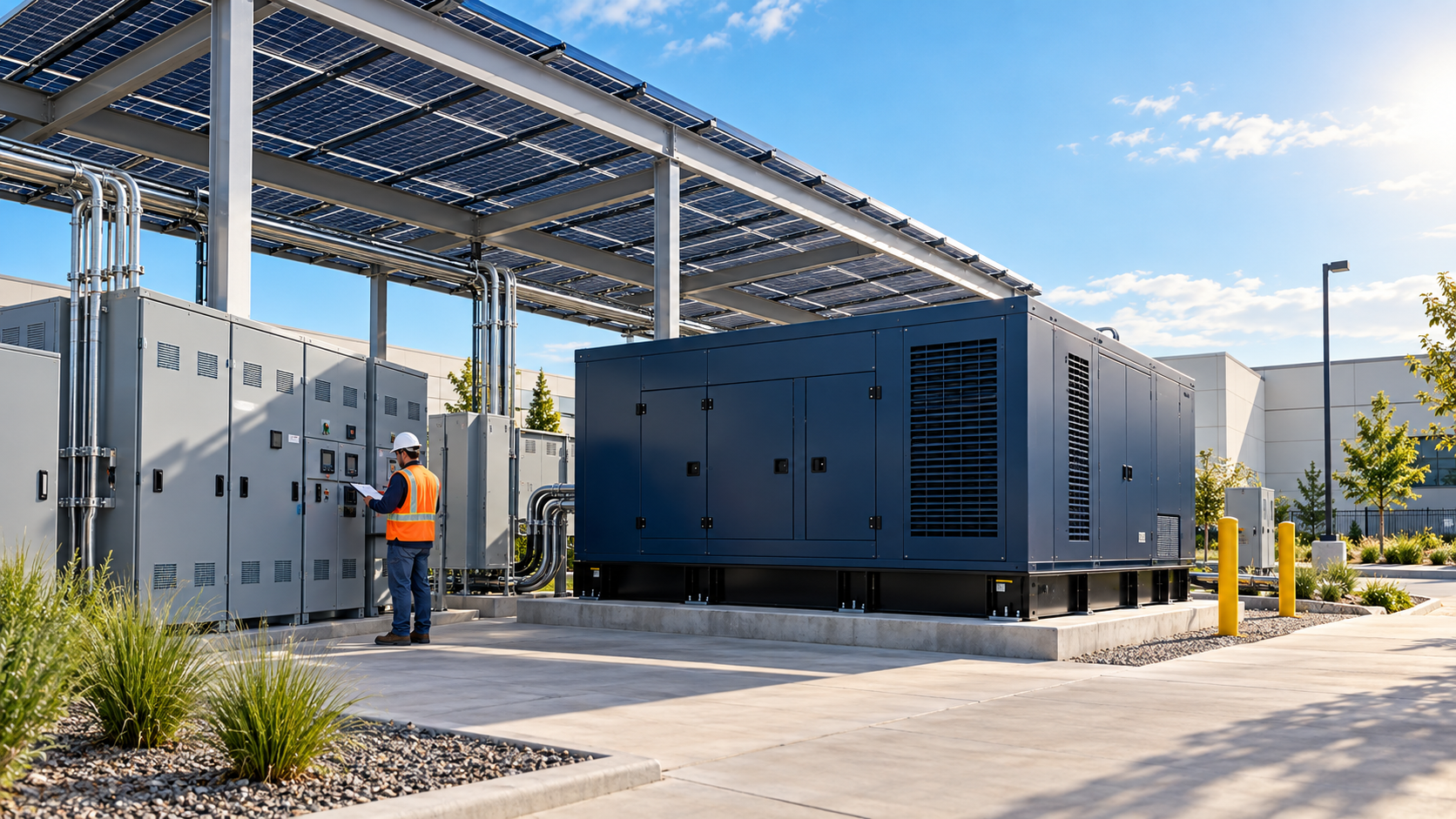
Many critical facilities in Kenya already rely on diesel generators. Hospitals, factories, hotels, telecom sites, schools, and remote camps often use generators to keep essential operations running during outages. Adding solar can reduce fuel cost and grid dependence, but it must be integrated carefully.
Solar cannot be treated as an isolated add-on
A solar plant connects into a live electrical ecosystem. That ecosystem may include utility supply, automatic transfer switches, generator controls, essential-load boards, capacitor banks, motor loads, and sensitive equipment. If solar is added without studying these interactions, the site may face instability, nuisance trips, reverse power risks, or poor generator loading.
Generator loading is a key design concern
Diesel generators need sufficient load to operate properly. When solar production is high and site demand is low, the generator may be pushed into inefficient or unsafe low-load operation. In some systems, reverse power protection and careful control logic are required to prevent solar from feeding back into the generator.
This is why system sizing and control strategy matter. The solar plant should support the facility without compromising generator operation during outages.
Critical loads should be clearly separated
Facilities with essential operations need clear load hierarchy. Critical loads may include medical equipment, refrigeration, security, ICT, water systems, lighting, and selected production processes. Non-critical loads may be shed or left off backup circuits during outages.
Solar and generator integration should respect this hierarchy. A good design makes it clear which loads are supported, how power changes over during outages, and what operators should expect.
Monitoring improves confidence
For critical facilities, visibility is important. Operators should be able to understand solar production, facility demand, generator state, inverter status, and faults. Monitoring does not replace engineering, but it helps teams make better operating decisions and detect issues before they become expensive failures.
Commissioning should test real scenarios
Commissioning should go beyond confirming that equipment turns on. The system should be tested under realistic grid, solar, generator, and load conditions. Changeover behavior, protection devices, emergency stops, alarms, and monitoring should all be checked and documented.
Integration checklist
- Review existing single-line diagram and generator controls.
- Confirm critical and non-critical load separation.
- Assess generator minimum loading and reverse-power risk.
- Define inverter operating mode and protection settings.
- Test changeover, shutdown, alarms, and monitoring during commissioning.
The goal is resilient energy
Solar and generator integration is not just a fuel-saving exercise. For critical facilities, it is a reliability exercise. The best systems reduce operating cost while keeping backup power stable, predictable, and safe for the people who depend on it.